Our Services → Learning Support
Learning Delay Assessment & Support
When school becomes a struggle, it is not about intelligence — it is about finding the right key. Our educational psychologists use standardised assessments to uncover how your child learns best, identify specific challenges, and create a personalised plan that turns frustration into confidence.
✓ Cognitive & achievement testing
✓ School collaboration
✓ Personalised learning plans

Understanding Learning Challenges
Learning Delays vs. Learning Disabilities
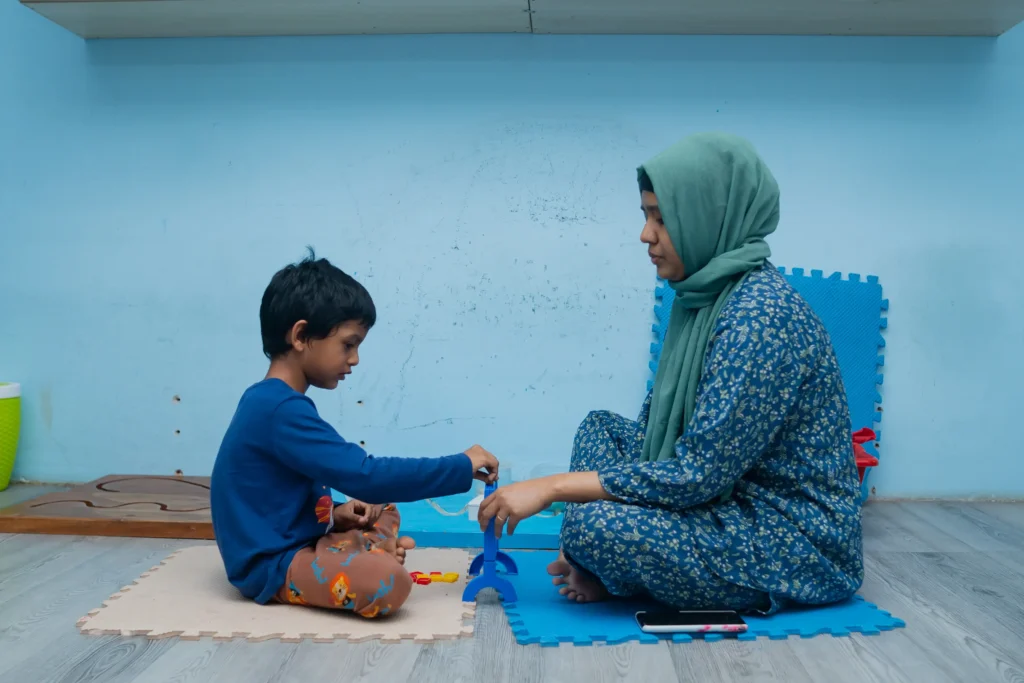
It is important to understand the distinction. A learning delay means your child is developing academic skills more slowly than peers but is expected to catch up with the right support. A learning disability (such as dyslexia, dyscalculia, or dysgraphia) is a specific neurological difference in how the brain processes certain types of information — it is lifelong but highly manageable with appropriate strategies.
In Bangladesh, academic pressure can be intense, and many bright children struggle not because they lack ability but because they learn differently. Our assessment identifies whether your child has a delay, a specific learning disability, or another factor affecting their school performance — and most importantly, what will help.
“A learning difficulty is not a measure of intelligence. Some of the most creative, innovative minds learn differently. Our job is to find the approach that unlocks each child’s potential.” — Shanta Islam, Founder
Signs to Watch For
If your child consistently shows several of these patterns at school or at home during academic activities, a learning assessment can help identify what is going on and how to help.
📖 Reading Difficulties
Struggles to recognise letters or sounds, reads very slowly, frequently guesses words, or has difficulty understanding what they have read.
✏️ Writing Challenges
Messy handwriting despite effort, difficulty organising thoughts on paper, persistent spelling errors, or avoidance of writing tasks altogether.
🔢 Maths Difficulties
Struggles with basic number concepts, cannot remember maths facts, has trouble understanding word problems, or confuses mathematical operations.
🐌 Very Slow Work Completion
Takes significantly longer than classmates to finish schoolwork. Homework that should take 30 minutes takes two hours despite your child trying hard.
😰 School Avoidance or Anxiety
Your child resists going to school, complains of headaches or stomach aches on school days, or becomes tearful about homework and tests.
🧠 Gap Between Ability and Performance
Your child seems bright and capable in conversation but school results do not reflect their intelligence. Teachers say they are “not reaching their potential.”
🔠 Letter and Number Reversals
Frequently reverses letters (b/d, p/q) or numbers beyond the expected age, or reads words backwards consistently after peers have stopped.
📋 Difficulty Following Multi-Step Directions
Cannot remember or follow sequences of instructions in class. Needs frequent repetition and struggles with multi-step academic tasks.
Our Assessment Approach
Comprehensive Learning Assessment
Our educational psychologists use a battery of standardised tools to build a complete picture of your child’s cognitive abilities, academic skills, and processing strengths.
WISC-V
The Wechsler Intelligence Scale for Children measures five areas of cognitive ability — verbal comprehension, visual-spatial, fluid reasoning, working memory, and processing speed — revealing your child’s unique cognitive profile.
WIAT-III
The Wechsler Individual Achievement Test assesses reading, writing, mathematics, and oral language skills, allowing us to compare academic performance with cognitive potential to identify specific learning gaps.
Beery VMI
The Beery-Buktenica Developmental Test of Visual-Motor Integration assesses how well your child coordinates visual perception with hand movements — critical for handwriting, copying, and drawing tasks.
CTOPP-2
The Comprehensive Test of Phonological Processing evaluates sound awareness, phonological memory, and rapid naming — key skills that underpin reading. Essential for identifying dyslexia patterns.
What to Expect
Our learning assessment is designed to be engaging for your child and informative for your family. Here is the journey from first call to action plan.
1
Initial Consultation
We meet with parents to understand your child’s school history, academic concerns, strengths, and your family’s goals. Bring report cards and any teacher feedback you have received.
2
Testing Sessions
Over 2–3 sessions, your child completes cognitive and academic assessments in a comfortable, encouraging setting. We make it as enjoyable as possible — many children tell us it felt like “puzzle games.”
3
Report & Recommendations
You receive a comprehensive report explaining your child’s learning profile, strengths, challenges, and specific recommendations for home, school accommodations, and any additional support needed.
4
School Collaboration
With your permission, we share findings with your child’s school and help teachers implement accommodations. We provide follow-up support to ensure recommendations are being carried out effectively.
Frequently Asked Questions
Does a learning disability mean my child is not intelligent?
Absolutely not. Learning disabilities occur in children of all intelligence levels, including those who are gifted. A learning disability means the brain processes certain types of information differently. With the right strategies and accommodations, children with learning disabilities can and do excel academically.
Will schools in Bangladesh accommodate learning differences?
Many schools in Dhaka and Chittagong are increasingly receptive to accommodations when provided with a clear professional report. Common accommodations include extra time on exams, modified homework, preferential seating, and alternative assessment methods. Our team helps families navigate these conversations with schools.
What age is best for a learning assessment?
Learning assessments are most commonly conducted from age 6 onwards, when children have had sufficient exposure to formal academic instruction. However, early readiness assessments can be done from age 4–5 if there are concerns about school preparedness. If your child is struggling at any age, it is worth seeking guidance.
My child only struggles in one subject. Is that enough to warrant an assessment?
Yes. Specific learning disabilities often affect only one domain — for example, a child may excel in maths but struggle significantly with reading (dyslexia), or be a strong reader but find maths very difficult (dyscalculia). A targeted assessment can identify the specific area and provide focused intervention strategies.
Can tutoring alone fix a learning disability?
Traditional tutoring (more of the same teaching) is often not enough for children with learning disabilities. They need specialised strategies that match how their brain processes information. Our assessment identifies the specific approach your child needs, which may include specialised tutoring methods, assistive technology, and classroom accommodations working together.
Related Services
Learning challenges often connect with other developmental areas. These services can provide complementary support.
⚡
ADHD Evaluation
Attention difficulties are a common co-occurring factor in learning challenges. An ADHD evaluation can determine if attention is contributing to academic struggles.
🗣️
Speech & Language Therapy
Language skills are the foundation of reading and writing. Children with language difficulties often benefit from combined speech therapy and learning support.
📊
Developmental Assessments
For younger children, a broader developmental assessment can identify whether learning difficulties are part of a wider developmental pattern that needs comprehensive support.